DL
DLDelta Air Lines
…2025 Departures
…Load Factor
DLJust like United, Delta is one of the two most well respected and successful airlines currently flying in the U.S. airline industry. Their premium and international travel is unmatched amongst U.S. airlines cited by the fact that their revenue from their premium product outpaces their revenue from economy. That is a remarkable achievement for any airline and speaks to the quality of the product they have built.
Although a long time ago, my first ever flight was on a Delta Shuttle flight between ISP and MCO. Much has changed since, but Delta seems to have morphed into a quality brand. We nearly had to pivot to a last minute Delta flight when our booking with Condor Airlines for a transatlantic flight in 2023 was in jeopardy. That experience reinforced something: for any international flight, Delta is the kind of airline you want to be on when things go sideways or want to avoid issues all together.
If you're flying internationally or domestically and looking for a safe, comfortable experience, Delta is a great option. If you are looking to save a buck, flying economy on a low cost airline might be a better choice for you. But if the trip matters whether that's a business flight or an international journey, Delta is hard to argue against.
Delta Air Lines operates from hubs in Atlanta, New York (JFK and LGA), Seattle, Boston, Minneapolis, Detroit, and Salt Lake City, covering virtually every major U.S. market along with a large transatlantic operation. Atlanta is the anchor: one of the busiest airports in the world, it gives Delta an unmatched domestic connection network, particularly into the Southeast and Midwest.
5 hubs
The airports where Delta Air Lines concentrates the most flights and connections, typically where it bases aircraft and crew.
Find direct flights from any U.S. airport — no booking pressure, no tracking.
Per-aircraft performance, 2025
How efficiently Delta Air Lines uses each aircraft type it flies: load factor, seats per flight, and passengers per departure, broken down by airplane model.
Highest-volume city pairs by seat volume
The busiest routes Delta Air Lines flies by total seats, split into domestic and international. Ranked by volume, not necessarily by profitability.
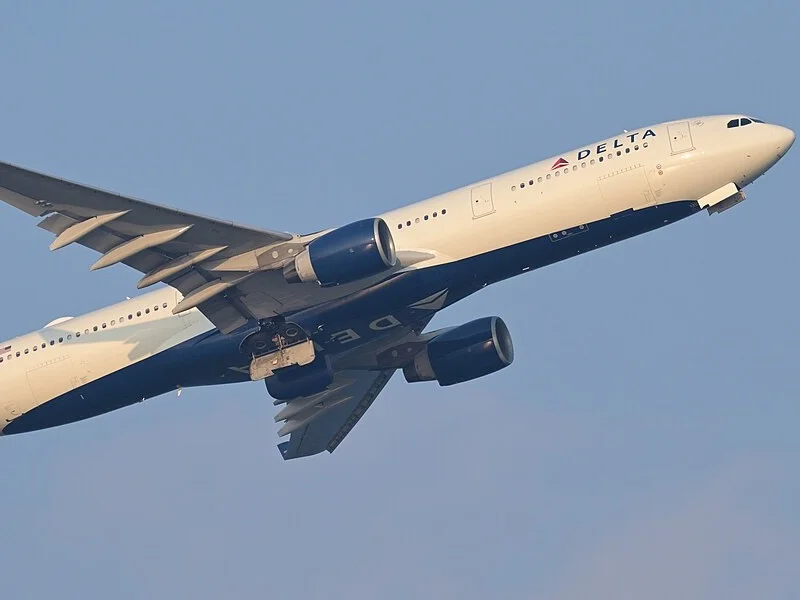
Delta sports a wonderfully high load factor. One of the highest amongst the legacies. They are also interestingly running a mixed fleet of Airbus and Boeing planes. While they are going through a fleet modernization, their Boeing 767-300ER garners some of the highest load factors in the entire fleet. Delta deploys this type on high-yield transatlantic routes where widebody demand is consistently strong, which explains the numbers.
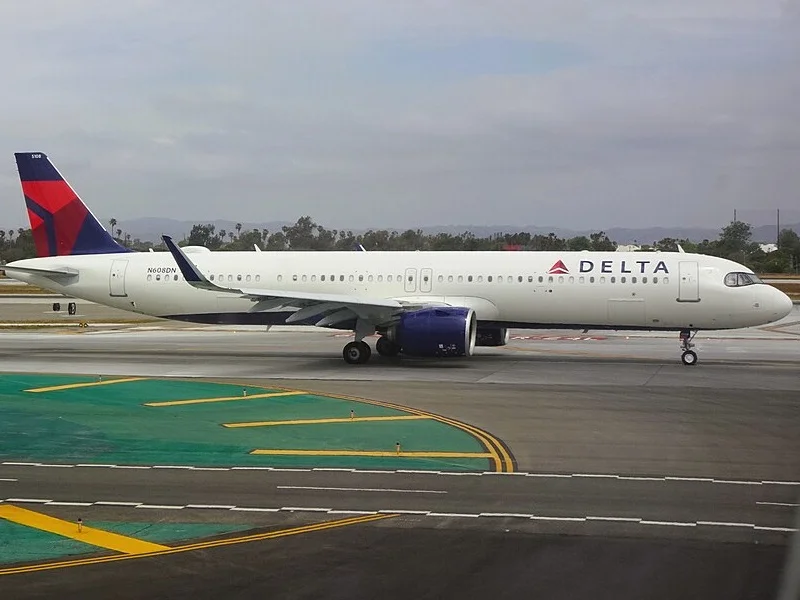
With 17 distinct aircraft types in 2025, Delta's fleet is the most complex of any U.S. carrier. A legacy of absorbing Northwest Airlines and decades of varied orders. The A321neo and A330-900neo stand out as the most efficiently loaded newer aircraft, signaling where Delta is putting its newest metal.DAL will soon be adding Boeing 787 Dreamliners to be used alongside their Airbus A350s.
Understanding route metrics for Delta Air Lines
Load factor is the percentage of available seats filled with paying passengers. A route running at 85% or above is considered healthy and signals strong demand relative to capacity. When Delta Air Lines routes dip below 75%, it often means the airline is over-scheduling relative to demand, which can lead to fare cuts, frequency reductions, or eventual suspension. Routes where the load factor has declined more than 5 points versus the historical average are flagged in our Stability scoring, since sustained low fill rates are one of the strongest early indicators of a route being pulled.
Route Stability reflects how consistently a route has been operated over time and how healthy it looks today. Lower scores, flagging a route as Stability Watch or At Risk, are driven by a combination of factors: declining year-over-year passenger numbers, load factors below 75% (meaning seats are going empty), frequency cuts in 2024–2025 relative to 2023, and a history of suspension during COVID with a slow recovery. A route that Delta Air Lines skipped during 2020–2021 and never fully restored will carry a resilience penalty that drags the overall stability score down.
Route Dominance looks at Delta Air Lines's share of that route specifically. It is driven purely by Delta Air Lines's seat share on each route: Sole Operator means Delta Air Lines is the only nonstop carrier; Monopoly means it holds over 70% of seats; Dominant means 40–70%; below that falls into Competitive or Minor territory. High dominance on a busy route signals strong pricing power and low substitution risk for travelers.
Airport Commitment scores how deeply invested Delta Air Lines is at each airport it serves, specifically whether it's growing, holding steady, or pulling back. A Dominant or Committed label means the airline has meaningful seat share, stable or growing capacity, and strong route completion rates at that airport. A Marginal or Retreating label means thin seat share, capacity cuts since 2022, or a pattern of cancellations. Hub airports like Delta Air Lines's primary bases will always score highest; airports where it operates only one or two seasonal routes will score lowest.