UA
UAUnited Airlines
…2025 Departures
…Load Factor
UAUnited is one of the two top airlines of the U.S. airline industry. If you want to fly in comfort to just about anywhere in the world, United is a solid choice. They are a strong pick for business travel across the country or international flights abroad, backed by the Star Alliance, the world's largest airline alliance which gives United passengers connectivity across hundreds of partners globally.
I took a United Express flight between EWR and GRR several years ago and was pleasantly pleased with the experience. The headaches of flying from Newark are more associated with the layout of the airport rather than the airline itself. The seats on their Embraer 175 are comfortable, and while in-flight entertainment was limited to personal devices, the system was responsive. The full United experience is likely even stronger at the premium and international level, where their Polaris business class product has earned strong reviews.
United is a pretty solid choice for just about any type of flight you need. They do seem to have less depth than American on flights down to Latin America and the Caribbean. For those markets, JetBlue or American might serve you better. But for domestic business flying, transcontinental routes, and international travel to Europe and Asia, United is a top-tier option.
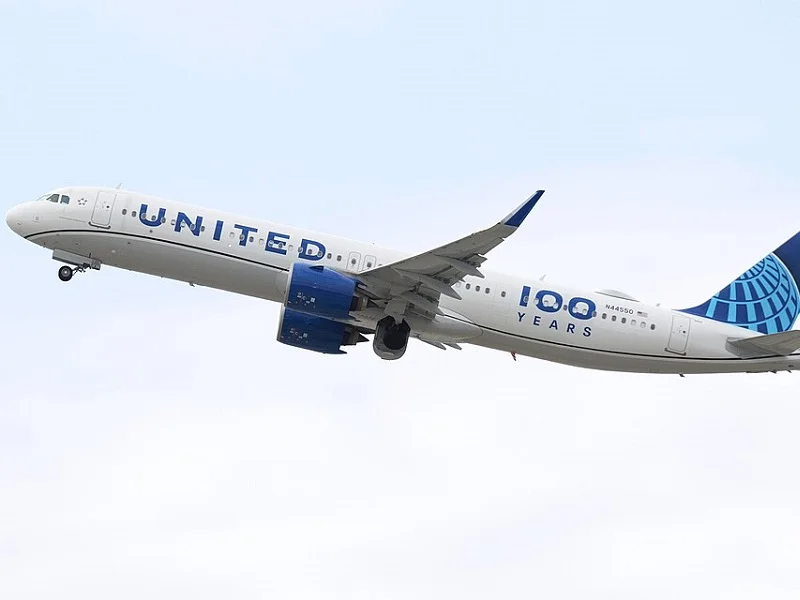
The airline is also one of the more innovative on the market. They are constantly improving their product and are in the midst of adding new planes to their fleet, including the Airbus A321XLR for thinner international routes.
United Airlines flies to more than 200 destinations across the U.S. and internationally through hubs in Chicago O'Hare, Denver, Newark, Houston, Los Angeles, San Francisco, and Washington Dulles. Its Pacific network is the standout: United holds more nonstop capacity to Japan, China, and Australia than any other U.S. carrier.
7 hubs
The airports where United Airlines concentrates the most flights and connections, typically where it bases aircraft and crew.
Find direct flights from any U.S. airport — no booking pressure, no tracking.
Per-aircraft performance, 2025
How efficiently United Airlines uses each aircraft type it flies: load factor, seats per flight, and passengers per departure, broken down by airplane model.
Highest-volume city pairs by seat volume
The busiest routes United Airlines flies by total seats, split into domestic and international. Ranked by volume, not necessarily by profitability.
United's top routes domestically are their high-yield flights between business centers like New York to San Francisco being the marquee corridor. The airline primarily operates Boeing 737s but on these particular routes you might find yourself on widebodies or the aging Boeing 757, which United continues to rely on for certain high-demand domestic and transatlantic segments.
With 18 aircraft types in 2025, United operates the most diverse fleet of any U.S. carrier. The load factor data shows widebody types consistently outperforming narrowbodies, a sign that United's long-haul international network is running efficiently, particularly on the Pacific routes where it holds more nonstop capacity than any other U.S. airline.
Understanding route metrics for United Airlines
Load factor is the percentage of available seats filled with paying passengers. A route running at 85% or above is considered healthy and signals strong demand relative to capacity. When United Airlines routes dip below 75%, it often means the airline is over-scheduling relative to demand, which can lead to fare cuts, frequency reductions, or eventual suspension. Routes where the load factor has declined more than 5 points versus the historical average are flagged in our Stability scoring, since sustained low fill rates are one of the strongest early indicators of a route being pulled.
Route Stability reflects how consistently a route has been operated over time and how healthy it looks today. Lower scores, flagging a route as Stability Watch or At Risk, are driven by a combination of factors: declining year-over-year passenger numbers, load factors below 75% (meaning seats are going empty), frequency cuts in 2024–2025 relative to 2023, and a history of suspension during COVID with a slow recovery. A route that United Airlines skipped during 2020–2021 and never fully restored will carry a resilience penalty that drags the overall stability score down.
Route Dominance looks at United Airlines's share of that route specifically. It is driven purely by United Airlines's seat share on each route: Sole Operator means United Airlines is the only nonstop carrier; Monopoly means it holds over 70% of seats; Dominant means 40–70%; below that falls into Competitive or Minor territory. High dominance on a busy route signals strong pricing power and low substitution risk for travelers.
Airport Commitment scores how deeply invested United Airlines is at each airport it serves, specifically whether it's growing, holding steady, or pulling back. A Dominant or Committed label means the airline has meaningful seat share, stable or growing capacity, and strong route completion rates at that airport. A Marginal or Retreating label means thin seat share, capacity cuts since 2022, or a pattern of cancellations. Hub airports like United Airlines's primary bases will always score highest; airports where it operates only one or two seasonal routes will score lowest.